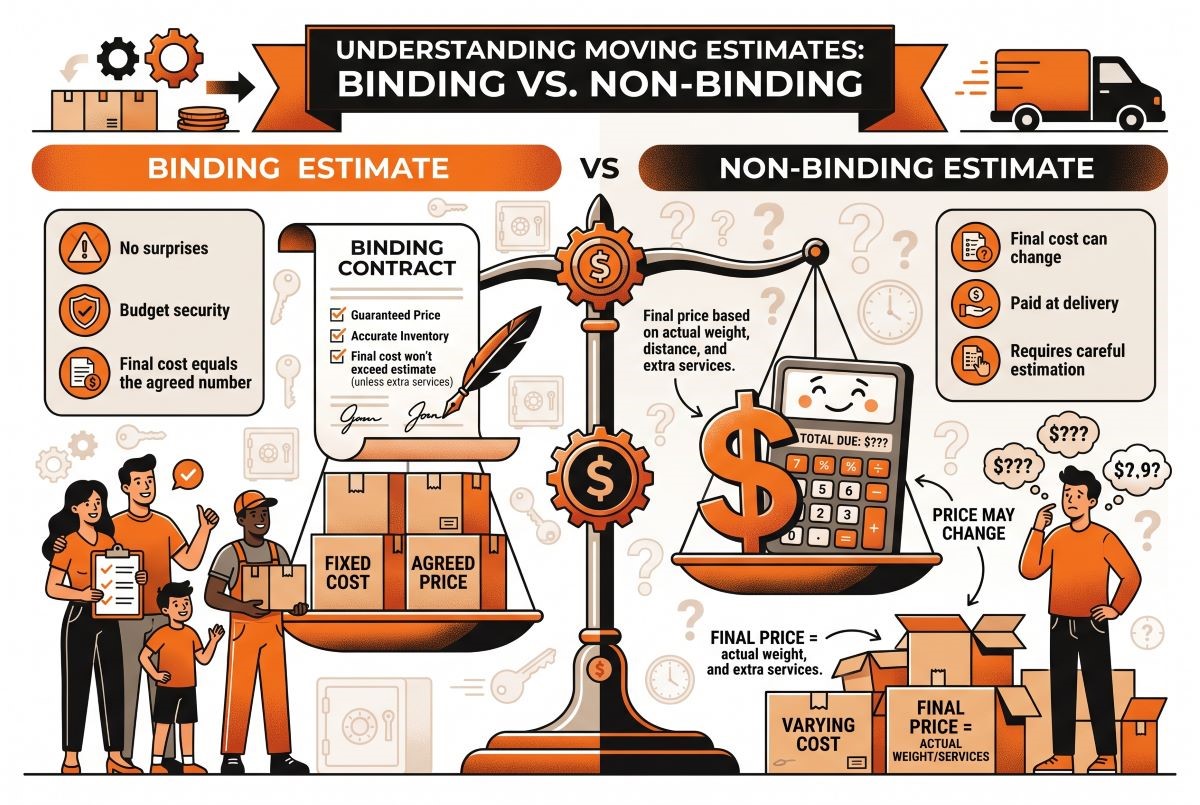
Few elements impact your moving day experience as directly as the contract type you sign with your moving company. Because your chosen estimate dictates the exact method used to tally your final charge, grasping how these agreements function prevents costly surprises once your possessions are loaded onto the truck.
Professional movers typically present customers with two foundational agreement models—binding and non-binding—alongside an advantageous hybrid standard known as binding-not-to-exceed. Exploring the mechanics of each agreement helps you select the right safeguard for your moving budget.
1. Demystifying the Binding Estimate
Opting for a binding estimate creates a legally enforceable contract that guarantees a set price for your entire relocation. The moving company calculates this total based on an initial inventory assessment and the specific add-on services you select.
Price Certainty: Your final payment remains completely static, regardless of whether the physical weight of your cargo exceeds or falls short of the initial calculation.
Inventory Restrictions: Every rate guarantee relies strictly on the itemized inventory taken during your quote survey. Introducing unexpected boxes, furniture pieces, or last-minute labor requests on moving day grants the carrier authority to revise or void the original contract.
Settlement Timing: Full payment of the agreed figure is required prior to the crew offloading your household goods at the new residence.
Primary Benefit: Complete protection against sudden price hikes caused by heavy cargo.
Primary Drawback: No opportunity to pay less if your shipment weighs significantly less than estimated.
2. Demystifying the Non-Binding Estimate
Rather than establishing a set fee, a non-binding estimate serves as a preliminary quote outlining expected project costs. Your ultimate out-of-pocket expense depends entirely on the certified scale weight of your shipment combined with additional hourly or accessorial service fees.
Flexible Billing: Your total cost scales dynamically with your cargo weight. Shipping less weight than anticipated reduces your bill, whereas packing heavier increases your financial responsibility.
The Federal 110% Delivery Rule: For interstate moves across state lines, federal regulations bar movers from demanding more than 110% of the non-binding estimate value to unload your truck. Carriers must bill any remaining balance above that 110% threshold separately, granting a 30-day window to complete payment.
Financial Risk: Price variability makes exact budgeting far more difficult to control.
Primary Benefit: Direct savings if you successfully downsize your belongings before moving day.
Primary Drawback: Potential for steep bill increases if the initial weight calculation was inaccurate.
3. The Balanced Alternative: Binding Not-to-Exceed Quotes
When evaluating contract options, requesting a Binding Not-to-Exceed estimate (frequently referred to as a "Guaranteed Cap" estimate) provides the highest tier of consumer protection.
This hybrid structure merges the strongest advantages of both traditional contracts:
If your shipment weighs more than expected, your bill remains locked at the agreed-upon maximum price ceiling.
If your shipment weighs less than expected, your final bill automatically drops to match the lighter scale weight.
Contact Coleman Hawaii movers today to learn more about our long distance moving services and schedule an in-home written moving estimate. Give us a call or fill out our online form to get started.
Subscribe to Coleman Hawaii Movers's Blog














Comments